
Research and Publications at Kaingo Game Reserve
Explore published research, academic contributions and field reports documenting the biodiversity, ecology and archaeological heritage of
Kaingo and the Waterberg region.
Archeology
L. Wadley, G. Laue & W. Biemond (2026)
This study examines bored sandstone disc fragments recovered from Welgevonden and Dwaalhoek 11 rock shelters at Kaingo. The authors explore their possible connections to rain-control rituals associated with both Iron Age farming communities and San hunter-gatherers, offering insight into the ritual practices of past communities in the Waterberg.
Bored Discs of Stone and Rain Control in Kaingo Game Reserve, Limpopo Province, South Africa


G. Laue & L. Wadley (2026)
Focusing on the rock art at Sheep Rock Shelter, this study identifies seven distinct phases of artistic activity. It explores how hunter-gatherer, farmer and possibly herder communities contributed to the site's layered visual record, revealing how different groups used the same shelter over time.
Diverse Performances on a Shared Stage: Rock Art of Kaingo Sheep Rock Shelter, Waterberg, South Africa
L. Wadley, W. Biemond, G. Laue, R. Moll, C. Sievers & B. Zwane (2026)
This publication investigates archaeological evidence from Welgevonden Rock Shelter to explore how people lived and used the site during the Later Stone Age. Through the study of archaeological remains, it contributes to a broader understanding of past hunter-gatherer lifeways and human occupation in the Waterberg.
The Later Stone Age of Welgevonden Rock Shelter, Waterberg, Limpopo Province, South Africa

Northern Branch of ArchSoc: Artefacts (2026)
In June 2026, members of the Northern Branch of the South African Archaeological Society visited Kaingo Game Reserve for a guided exploration of its rock art heritage, led by Professor Lyn Wadley. The visit followed the launch of Rock Art of the Waterberg: Rites and Transformation, co-authored by Professor Wadley and Dr Ghilraen Laue.
The publication explores several significant archaeological sites within and around Kaingo, including Welgevonden, Dwaalhoek and Kaingo Sheep Rock Shelter. Through rock paintings, excavated artefacts and evidence of successive occupations, these sites offer insight into the diverse communities that have used the Waterberg landscape over thousands of years.
The account also highlights Kaingo’s growing contribution to archaeological research and the importance of preserving the region’s rich cultural heritage.
Rock paintings of Kaingo Game Reserve in the Waterberg


Dr Bongekile Zwane (2026)
An anthracological study led by Dr Bongekile Zwane at the University of Johannesburg examines wood charcoal recovered from three archaeological rock shelters in the Waterberg: Kaingo Sheep Rock Shelter, Welgevonden and Dwaalhoek 11.
Using high-powered microscopes to analyse the anatomy of ancient charcoal, researchers identified tree species gathered for firewood by people living in the region across different periods of prehistory. The findings provide insight into past vegetation, the use of local plant resources and the relationship between people and their environment over thousands of years.
The study highlights how archaeological remains can reveal both the region’s changing ecological history and the ways earlier communities interacted with the landscape.
Trees of the Prehistoric Waterberg
L. Wadley & G. Laue (2025)
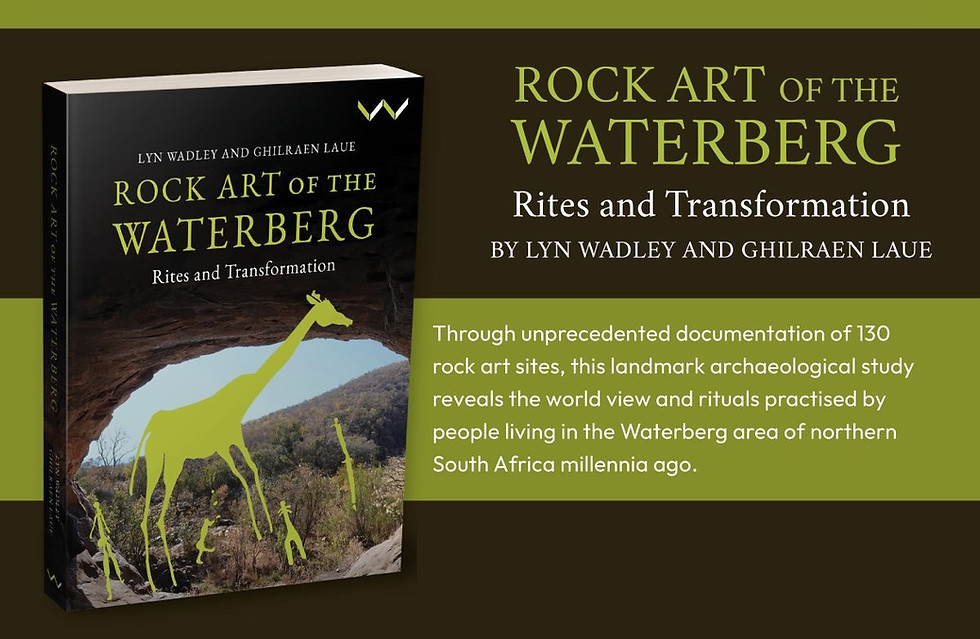
This book explores the rock art of the Waterberg, examining its relationship with ritual, cultural practices and transformation. Drawing on multiple rock art sites, including sites at Kaingo, it places the reserve's archaeological heritage within the wider cultural and historical landscape of the region.
Rock Art of the Waterberg: Rites and Transformation
L. Wadley, W. Biemond, G. Laue, C. Sievers, C. Thorp & M. de Kock (2023)
This study explores archaeological evidence from Woodstock, documenting a long history of human activity in the Waterberg, from the Acheulean period of the Early Stone Age through to the Iron Age. The research highlights the archaeological significance of the area and its contribution to understanding the region's past.
Woodstock Rocks: From Acheulean to Iron Age in the Waterberg, Limpopo Province, South Africa

L. Wadley, A. R. Antonites, W. Biemond, T. Hodgskiss, Z. Jacobs, G. Laue, G. Mauran, C. Sievers, C. Thorp & B. Zwane (2022)
This research examines archaeological evidence from Sheep Rock Shelter to investigate how people used the site during the Late Holocene. The findings contribute to a deeper understanding of past human activities, material culture and the ways communities occupied and interacted with this part of the Waterberg landscape.
Late Holocene Use of Kaingo Sheep Rock Shelter in the Western Waterberg, Limpopo, South Africa

Ecology, Biodiversity, and Water
This study documents freshwater fish diversity across the Waterberg aquatic ecoregion and examines the taxonomic uncertainties and conservation threats affecting its fish communities. The researchers identified 29 fish species and found evidence of distinct genetic lineages in four species, suggesting that the region may harbour previously unrecognised biodiversity. The findings highlight the importance of further research and freshwater conservation in the Waterberg.
Freshwater Fishes of the Waterberg Aquatic Ecoregion, South Africa: Diversity, Taxonomic Conflicts and Conservation Concerns

Drawing on more than 40 years of spider surveys, this study presents the first annotated checklist of spiders recorded in the Waterberg District. The research documents 600 species across 54 families, including nine species endemic to the district, and assesses their distribution and conservation status. It provides an important contribution to understanding and conserving the Waterberg's invertebrate diversity.
The Faunistic Diversity of the Spiders (Arachnida, Araneae) of the Waterberg District in the Limpopo Province of South Africa

This study investigates how climate variability and topography influence wetland resilience across the Waterberg Mountain Complex. Using climate and vegetation data from 11 wetlands, the researchers examine rainfall patterns, temperature trends and drought impacts. The findings indicate that high-altitude wetlands may be more resilient to climatic pressures than lowland wetlands, providing valuable insights for wetland conservation and climate adaptation.
Hydroclimatic Variability and Topographic Mediation of Wetland Resilience in a Semi-Arid Mountain of the Waterberg Mountain Complex

This research investigates the patterns and factors influencing mammal diversity across the Waterberg mountain catchment area. The study includes a fine-scale assessment of ungulate occupancy at treated and untreated sites at Kaingo and Qwabi, contributing to a better understanding of mammal distribution and the ecological effects of management interventions.
Large Herbivores Are Linked to Higher Herbaceous Plant Diversity and Functional Redundancy Across Spatial Scales

This research investigates the patterns and factors influencing mammal diversity across the Waterberg mountain catchment area. The study includes a fine-scale assessment of ungulate occupancy at treated and untreated sites at Kaingo and Qwabi, contributing to a better understanding of mammal distribution and the ecological effects of management interventions.
Patterns and Drivers of Mammal Diversity Across the Waterberg Mountain Catchment Area, South Africa

This comprehensive illustrated field guide documents 317 species of trees, shrubs and climbers found in the Waterberg. Combining photographs, detailed botanical illustrations, distribution maps and accessible species descriptions, it supports the identification of woody plants and highlights the diversity of the region's indigenous flora. The book serves as a practical reference for researchers, conservation practitioners and nature enthusiasts interested in the Waterberg's plant life.
Trees & Shrubs of the Waterberg

This illustrated field guide documents 661 species of wildflowers found across the Waterberg region. Featuring more than 2,000 photographs, botanical illustrations and practical identification guides, the book provides a valuable resource for recognising the area's diverse plant life, including rare, threatened and endemic species. It contributes to a broader understanding of the Waterberg's botanical diversity and supports the identification and appreciation of its indigenous flora.
Wildflowers of the Waterberg

Economics
This article highlights Kaingo Game Reserve as the first reserve in South Africa to benefit from the Section 37D biodiversity tax incentive. Following the formal declaration of the 9,000-hectare Big Five reserve as a nature reserve through the biodiversity stewardship process, Kaingo received its first tax deduction at the end of 2016. The article illustrates how tax incentives can support private landowners in securing important biodiversity areas for long-term conservation.
SA Citizens Benefit From Biodiversity Tax Break

This article explores how South Africa's biodiversity tax incentive can support the financial sustainability of protected areas and encourage private landowners to commit land to conservation. It highlights the role of financial incentives in supporting biodiversity protection and long-term conservation management.
SA's Biodiversity Tax Incentive Taken to Scale
